
Keratin Tip Hair Extensions: A Complete I-Tip and U-Tip Buying Guide
Keratin tip hair extensions are the strand-by-strand category of the extension market. Instead of a weft or a panel, each unit is a single pre-bonded strand — hair tipped with keratin polymer and shaped for a specific attachment system. Installed one strand at a time, they give the most natural movement, the finest visual footprint, and the longest wear cycle of any method on the market. For salons they anchor the premium installation tier; for distributors they are the SKU line that trained stylists re-order on a predictable cycle.
They are also the category where buyers make the most expensive mistakes. Confusing an I-tip system with a U-tip system leaves you with stock that needs different tools than your installers carry. Ordering by strand count without checking grams per strand produces sets that look full in the catalogue and feel thin on the client. And committing to a wholesale lot based on photos alone — without bending a single bond — is how distributors end up with product that sheds at the tip within three weeks.
This guide walks through the keratin tip category the way a buyer needs it: how the tips are manufactured, what separates I-tip from U-tip, which specifications predict strand quality, and how to structure a sample order before any bulk commitment. If you are still mapping the broader method landscape for your clients, our tape-in vs. clip-in vs. sew-in comparison covers the client-facing differences; this article stays inside the keratin tip category, where the purchasing decisions are made.
What Are Keratin Tip Hair Extensions?
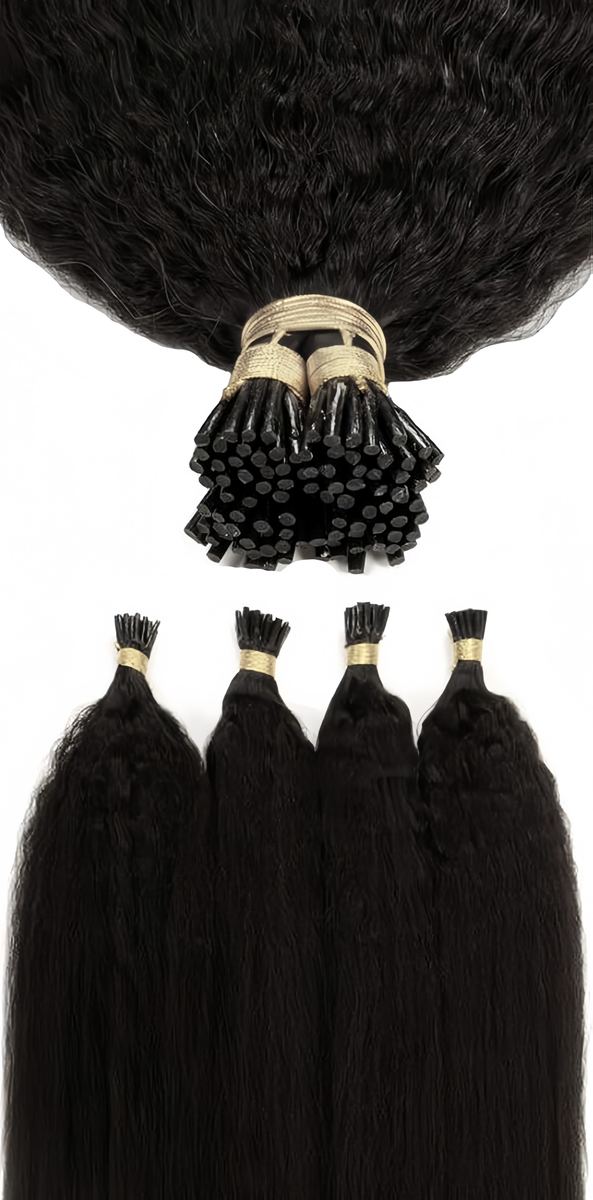
Every keratin tip strand has two components: the hair and the bond. The hair is typically 0.5 to 1 gram of aligned human hair drawn to a consistent length. The bond is a small amount of keratin-based polymer molded around the root end, shaped to match an attachment method. The strand is finished — cut, drawn, tipped — before it reaches the salon.
The shape of the tip defines the system:
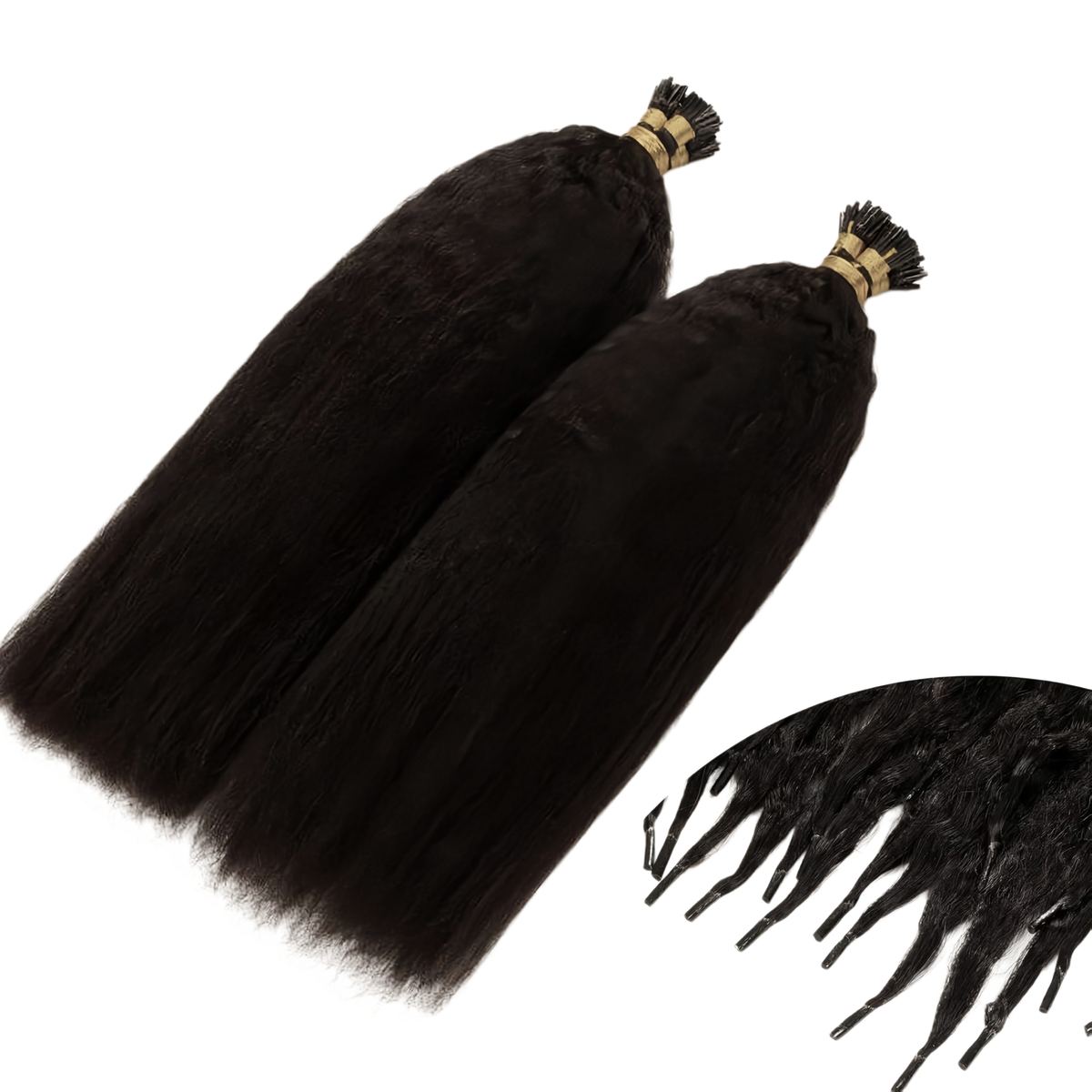
- I-tip (also sold as stick tip or round tip): the keratin is molded into a narrow round stick. It is never heated on the client's head. The installer threads a micro-bead or shrink tube onto the natural hair, inserts the I-tip strand, and crimps the bead shut.
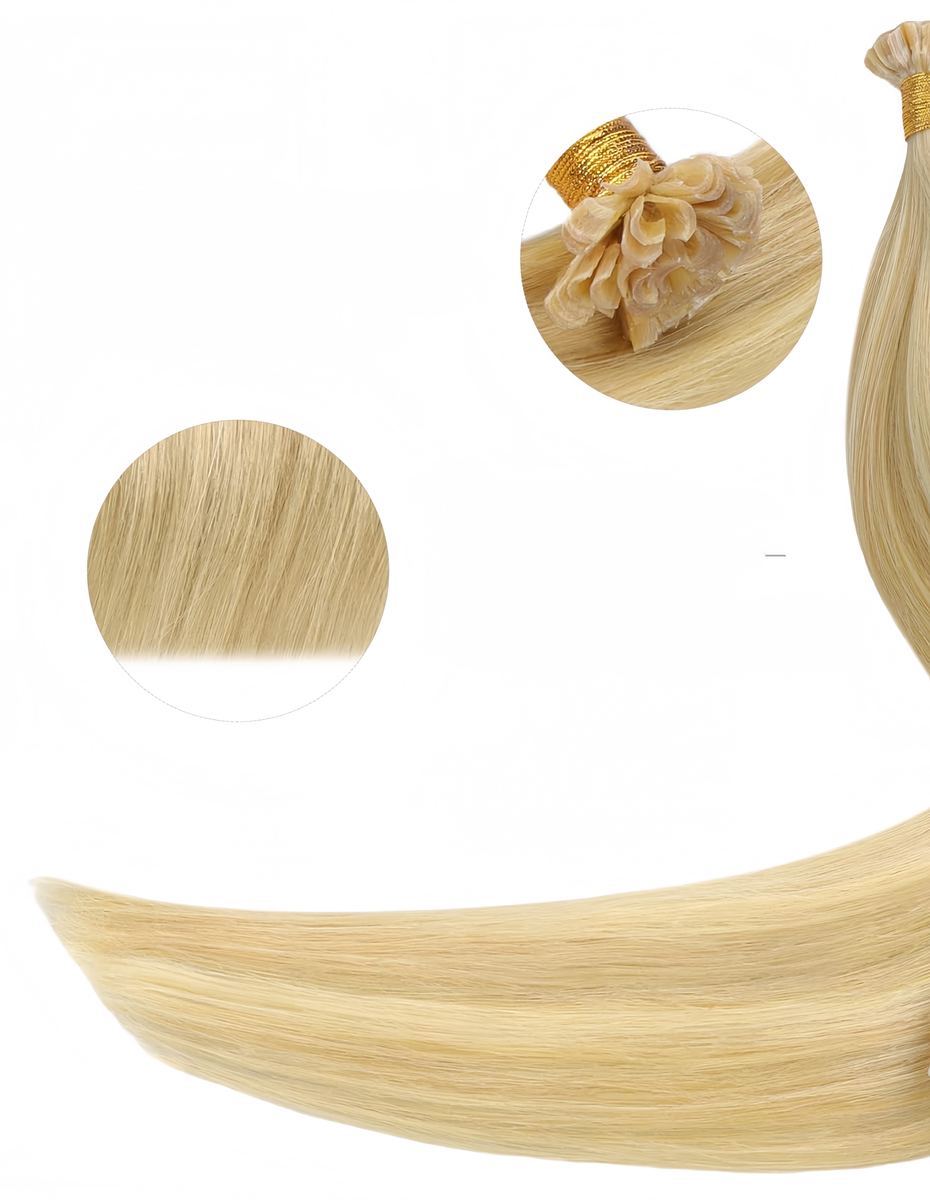
- U-tip (also sold as nail tip): the keratin is flattened into a U or nail shape designed to be melted. The installer wraps the softened keratin around a small section of natural hair with a fusion connector, forming a bond that hardens in seconds.
- Flat tip / V-tip: a lower-profile variant of the U-tip for clients who want the thinnest possible bond footprint.
- Micro-link: an I-tip variant supplied with the attachment link pre-attached, so the installer skips the separate bead-loading step.
Within those systems, the commercial variables are hair grade, length range, shade, and texture. A keratin tip catalogue built on 100% virgin human hair in a 14–24 inch range, customizable in color, length, and texture, covers the professional tier of the market — where stylists re-order by SKU code rather than by photo.
How Keratin Tips Are Manufactured — and Why the Process Predicts the Bond
When buyers complain about keratin tip extensions, they usually complain about one of two things: hair that sheds from the root, or bonds that crack, crumble, or slip. Both are manufacturing outcomes, not hair-quality mysteries.
The tipping process starts with bulk hair that has already been sorted and drawn. Strands of a fixed gram weight are separated, and the root ends are dipped into molten keratin and molded into shape — by machine on consistent production lines, by hand where labor is cheaper but tolerance is wider. The keratin formula is the second variable: higher-grade formulas stay slightly flexible after curing so the bond flexes with the hair; low-grade formulas cure brittle and flake within weeks of wear.
Ask a factory three questions before you price anything:
- Is the tipping machine-molded or hand-dipped? Machine-molded tips have consistent weight and shape, which matters when an installer counts strands per section.
- What is the keratin's softening behavior? A bond that never re-softens is convenient for wear but difficult to remove cleanly; a well-formulated bond softens under remover solution without dissolving into the hair.
- What is the tip retention result — the force required to pull hair out of a finished bond? Any factory doing quality control will have a number; "our bonds are strong" is not a number.
The hair side of the process matters just as much at the root end. Because every strand sits separately against the client's head, cuticle direction is visible in a way it never is on a weft — reversed cuticles catch light differently strand to strand and tangle within weeks. Our production line builds tip extensions from cuticle-aligned hair only; the reasoning is covered in the science of cuticle-aligned hair .
I-Tip vs. U-Tip: The Differences That Affect Your Service Menu
The two systems are not interchangeable, and the differences show up in equipment, appointment length, and how often the client returns.
Attachment. An I-tip strand is crimped into a micro-bead or shrink tube with pliers — a mechanical attachment with no heat applied to the client's head. A U-tip strand is melted with a fusion connector at roughly 160–180 °C and rolled around the client's own hair into a hardened bond. One is cold attachment, the other hot fusion.
Wear cycle. A well-formed U-tip fusion bond holds three to five months before maintenance. An I-tip bead grips firmly but sits a fixed distance from the scalp, so as natural hair grows the strand must be moved up — typically every eight to twelve weeks. Neither is "better"; they create different rebooking rhythms.
Skill and equipment. I-tip installation needs bead pliers and beads or tubes in two or three sizes. U-tip installation needs a fusion wand, finger shields, keratin granules for maintenance re-bonding, and remover solution for clean take-down. Most stylists learn I-tip faster; U-tip fusion rewards training with the longest-wearing result in the category.
Client fit. Fine hair and heat-sensitive clients lean I-tip — no thermal exposure, and the bead distributes tension. Clients who want the longest interval between appointments and the most seamless root blend lean U-tip.
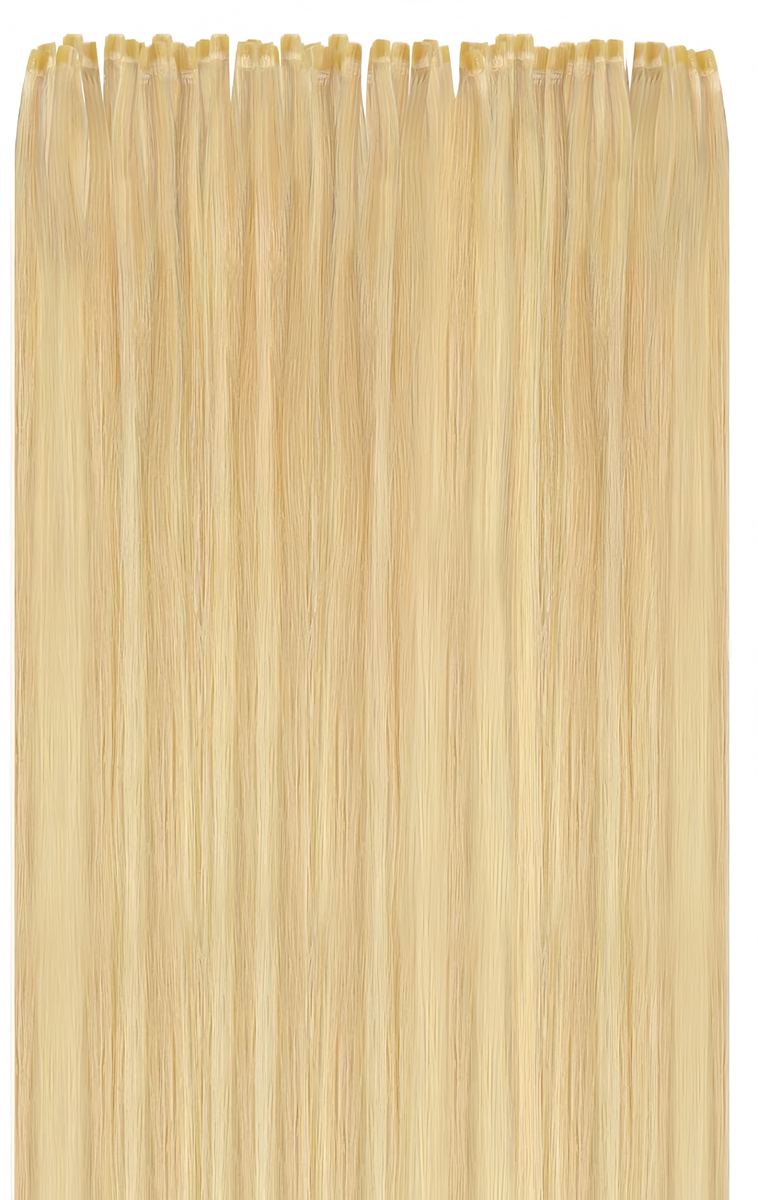
Stocking both systems is how a salon serves both demand profiles without turning clients away. On our own line, the kinky straight I-tip in #1B is the anchor cold-attachment SKU — a coarse Yaki texture built for Afro-textured and ethnic hair markets — while the highlighted golden blonde U-tip in #16/22 anchors the hot-fusion side with a two-tone highlight that sells a dimensional effect without in-chair color work.
The Specifications That Actually Predict Quality
A keratin tip spec sheet has four fields that separate professional product from catalogue filler. Check all four before comparing any two quotes.
Grams per strand. The single most abused number in the category. Strands run from 0.5 g to 1 g. A "200-strand full head" of 0.5 g strands delivers 100 g of hair — the same mass as 125 strands of 1 g hair, but with twice the attachment points and half the density per strand. Compare quotes per gram of usable hair, never per strand.
Drawn configuration. Single-drawn strands taper naturally, thicker at root than tip. Double-drawn strands are re-sorted so the full length stays near the root diameter — more expensive per gram, visibly fuller at the ends. For a premium installation tier, double-drawn is the defensible default.
Hair grade and cuticle direction. Remy means roots and tips run the same direction; non-Remy hair is acid-treated to strip misaligned cuticles, shortening usable life and dulling the strand. The commercial differences between the two grades — and why the price gap understates the performance gap — are laid out in Remy vs. non-Remy for wholesale buyers .
Shade and texture accuracy. Keratin tips are a color-coded SKU business, so shade drift between production batches is a real distributor problem. Solid shades like #1B, #1, and #2 are the stable base of any catalogue; highlight mixes like #16/22 and blended gradients like #P18/613 carry more complexity and should be sample-verified on every reorder. Texture range matters as much as color: a curly I-tip in #1 serves textured-styling demand that straight-only catalogues miss entirely.
Keratin Tip Systems at a Glance
| System | Attachment method | Heat on client | Wear cycle | Hair reusability | Typical client fit |
|---|---|---|---|---|---|
| I-tip (stick tip) | Micro-bead or shrink tube, crimped | None | Move-up every 8–12 weeks | High — re-bead the same hair | Fine hair, heat-sensitive clients, textured bases |
| U-tip (nail tip) | Keratin melted with fusion connector | Yes, ~160–180 °C | 3–5 months per set | Moderate — 1–2 re-tip cycles | Premium long-wear installations |
| Flat / V-tip | Low-profile keratin fusion bond | Yes | 3–5 months | Moderate — 1–2 re-tip cycles | Fine to medium hair, thinnest bond footprint |
| Micro-link | Link pre-attached, strand crimped | None | 8–12 weeks move-up | High | Long-term wear, darker bases such as #2 |
Read the table as a service-menu decision, not a ranking. A salon that books mostly heat-sensitive or fine-haired clients builds reorder volume on the first and last rows; a salon selling premium six-month installations builds it on the middle rows. If you are still deciding which extension categories your market will actually pay for, the framework in choosing the right extension type for your market applies directly to tip systems.
Order Economics: Strands, Grams, and What to Budget
Build the order math from the client's head upward.
A full head on fine to medium hair takes 100–125 strands; maximum-density looks take 150–200. At 1 g per strand, that is 100–200 g of hair per installation. At 0.5 g per strand you need double the strand count for the same mass, and the appointment runs longer because every attachment point is placed by hand.
Standard wholesale units in the category are 25-strand packs, so a salon stocking for one full-head installation orders four to six packs per client in its core shades. Distributors buying by weight should model their catalogue the same way: every SKU line is really "how many full heads per box, in which shades."
Price tiers follow three variables, in order of weight: hair grade (Remy versus virgin select), length (14–24 inch range prices stepwise), and color complexity (highlight mixes and blended gradients price above solid shades). What the tier does not follow is marketing language — "premium" is not a specification, and the per-gram comparison across two quotes usually exposes which one is padding.
On the retail side, keratin installations carry the highest service ticket in most salon menus. The pricing framework in how to price hair extensions for retail profitability maps directly onto bonded-installation services.
Sample economics are the last piece. Our tip SKUs sample from a single piece per style — color, texture, bond shape — so a buyer can verify five SKUs across the category for the cost of five units before committing to a wholesale lot.
The Sample Stage: Test Before You Commit to Bulk
Photos verify shade and shape. They do not verify a bond. Order physical samples and run a protocol on them:
- Bond pull test. Grip a finished strand at the bond and apply firm, steady force along the hair. A few loose hairs at the root are normal; shedding that visibly thins the bond means weak tipping. This test catches what photos cannot.
- Bond bend test. Flex the keratin tip 20–30 times between thumb and finger. It should flex without whitening, flaking, or cracking. Brittle bonds that powder at the flex point will fail on a client within weeks.
- Comb and dry test. Comb the strand root to tip, then repeat after a wash and blow-dry, and compare shed counts. Cuticle-aligned hair sheds minimally; direction-stripped hair worsens with every pass.
- Heat tolerance test. Run a flat iron over a washed strand at normal styling temperature. Gloss loss or fiber memory that will not recover signals processed or blended hair.
- Mass verification. Weigh the strand and measure the length. Confirm the promised grams per strand and the true length of the drawn configuration. Two minutes with a scale eliminates the most common wholesale dispute in the category.
The full five-method discipline — including the bleach test for grade verification — is covered in how to test hair extension quality , and every method applies to tip extensions unchanged.
Application Equipment and Training: Budget the Full System
The hair is half the investment. The other half is what your installers hold in their hands.
For I-tip services, the kit is short: bead pliers, a remover plier, and micro-beads or shrink tubes in two or three diameters to match client hair density. For U-tip services, the kit is a fusion wand with adjustable temperature, finger shields, keratin granules for maintenance re-bonding, and remover solution — plus enough practice hours that the installer forms bonds of consistent size and placement. Flat-tip systems share the U-tip kit.
Training economics are real but front-loaded: most fusion certifications run a few days, and practice heads cost a small fraction of the certification. Once trained, the installer carries the skill across every SKU in the catalogue — which is why training before deep inventory is usually the right order.
Retail inventory completes the system: a shade ring so clients commit to a color in the chair, spare beads for maintenance, and remover solution as a take-home add-on. Salons that stock the maintenance consumables capture the reorder cycle instead of sending it elsewhere.
Frequently Asked Questions
How many keratin tip strands does a full head need?
For fine to medium hair, 100–125 strands; for maximum density, 150–200. Multiply by grams per strand to get total mass — that number, not the strand count, tells you whether a quote delivers a full look. A "200-strand" package of 0.5 g strands is a 100 g package.
Which should a salon new to the category stock first, I-tip or U-tip?
Most start I-tip. Installation uses no heat, the attachment is reversible with the right pliers, and the learning curve is a single technique. U-tip fusion adds the longest wear cycle in the category but requires a fusion wand and real training before it goes on paying clients. Salons serving textured markets can start with a kinky straight I-tip SKU in #1B, where demand is deep and the cold-attachment method is an easy client conversation.
How long do keratin tip extensions last?
Separate the hair from the bond. Virgin hair with intact cuticles wears 9–12 months of client use, including removal and re-installation. The bond lasts 3–5 months on U-tip fusion before maintenance; I-tip beads need a move-up every 8–12 weeks as natural hair grows.
Can keratin tip hair be reused after removal?
Yes, and reuse is where the hair grade pays for itself. I-tip strands are removed, re-beaded, and installed again — the hair itself is unmodified. U-tip strands need re-tipping: old keratin is stripped and new bonds molded, viable for one to two cycles on cuticle-aligned hair. Non-Remy strands rarely survive the first removal.
Do keratin bonds damage natural hair?
Not when three conditions hold: sections are not overloaded with too many grams, the installer is trained, and removal uses the correct solvent rather than force. Damage cases in practice come from heavy strands on fine hair and from pulling bonds out dry — installer errors, not product errors.
Getting Started with Keratin Tip Sourcing
The keratin tip category rewards buyers who match the system to their service model, verify grams and bonds at the sample stage, and then reorder by SKU code on a predictable cycle. It is the premium installation tier of the market, and it behaves like one: quality gaps show up on clients' heads, within weeks, in ways that wefts can hide. If tape-ins anchor a salon's recurring-revenue program, keratin installations anchor its premium tier — the framework in our tape-in revenue and retention guide applies to bonded services with the same rebooking math.
Ready to build your sample order? Browse the tip extension range, note the SKU codes that match your market — straight, kinky, curly, highlighted — and send us your requirements . We ship samples from single pieces so you can run the bond tests above before committing to a wholesale lot.