
Tape-In Extensions for Salons: A Revenue and Client Retention Guide
Most extension methods let a salon sell hair once. Tape-ins let you sell the same client a service relationship that renews every six to eight weeks. That structural difference — not fashion trends — is why tape-in extensions have quietly become one of the most dependable revenue lines on a modern salon menu.
This guide is written for salon owners adding tape-ins to their menu or scaling an existing tape-in business. We will work through the numbers the way an owner needs them: how to price an installation, what one client is worth over twelve months, how much inventory to carry, and how to keep the cycle running. If you are still comparing methods from the client's point of view, our tape-in vs. clip-in vs. sew-in comparison covers those differences; this article stays on the business side of the ledger.
Why Tape-Ins Belong on Your Service Menu
Look at your service menu the way an accountant would. Clip-ins are a retail product: the client buys once, applies them herself, and revenue ends at the register. Sew-ins and keratin bonds generate long appointment hours but demand advanced skill and stress hair that may not tolerate the tension. Tape-ins sit in a different position entirely.
Three structural advantages make tape-ins the natural anchor for a recurring-revenue program:
- A built-in service cycle. Natural hair grows about half an inch a month, so a tape-in install needs a move-up appointment every six to eight weeks to keep the adhesive bands close to the scalp. Every installed client is a standing appointment you did not have to win twice.
- A consumable product behind the service. Virgin tape-in hair typically serves six to twelve months of wear with proper care, which means each client also repurchases hair roughly once or twice a year on top of the service fees.
- A realistic install window. A full-head tape-in application takes roughly 45 to 90 minutes — long enough to charge professional service rates, short enough to fit two or three installs into one stylist's day.
None of this happens automatically; the rest of this guide puts numbers on each advantage and turns it into a plan.
The Unit Economics: What One Tape-In Client Is Worth per Year
Before pricing anything, calculate what a retained tape-in client contributes over twelve months. The math is simple, and it reframes how much you can justify spending to acquire and keep one.
Take an illustrative case, not a promise: a client books a full install in January using 30 wefts of 18-inch hair, returns for move-ups every seven weeks, and replaces the hair after nine months of wear. Your calendar looks like this:
- 1 full installation (hair + application)
- 5 move-up appointments over the year (hair removed, repositioned, re-taped)
- 1 replacement set of hair late in the year
- Occasional add-ons: color services, trims, aftercare products
In the U.S. market, full-head tape-in installs commonly retail between $300 and $800 depending on region and hair length, with hair often billed separately or bundled into package pricing. Move-up services commonly run $100 to $250. Run the low-middle scenario and a single retained client generates well over $1,000 of annual revenue — with the hair itself typically accounting for only a third to half of that figure. The margin lives in the service hours, and the service hours exist only because the client keeps coming back.
Keep that number in mind when you evaluate suppliers: saving $1 per weft on hair that sheds after eight weeks costs you more than a replacement set — a client whose hair matted between appointments does not book her next move-up with you. If you are rebuilding retail pricing around services like this, our guide to pricing hair extensions for retail profitability walks through the markup logic in detail.
How to Price a Tape-In Installation
Installation pricing fails most often because owners price the product instead of the outcome. A workable quote has three layers, and each layer needs to cover its own job:
Layer 1 — Hair cost (COGS). Start with what the wefts actually cost you per install. A full head uses 20 to 40 wefts depending on the client's density and the look she wants. If you pay a wholesale price of a few dollars per weft for virgin hair, your hair cost per full install lands somewhere between $60 and $200 depending on length and grade. Know this number cold before you quote anything.
Layer 2 — Labor. At 45 to 90 minutes for an install and 60 to 75 minutes for a move-up, decide what your stylist's chair time must earn per hour, then divide. If the chair needs to generate $60 an hour, a 90-minute install carries $90 of labor minimum.
Layer 3 — Overhead and margin. Adhesive, remover, aftercare kit, credit card fees, rebooking tools, and a margin for the inevitable redo. Many owners skip this layer and wonder why a "profitable" install rate never shows up in the bank account.
Two practices separate salons that make money on tape-ins from those that do not:
- Quote the install as a package — hair plus application plus first move-up bundled — rather than itemizing hair at retail plus a discounted service. Packages anchor the client on the result, protect your margin, and make the comparison shopper's job harder.
- Charge move-ups as their own service line, never as a favor folded into a color appointment. The move-up is where a tape-in program either compounds or quietly bleeds out.
Set your published rates from those three layers, then check them against your local market. If your rate lands below what the layers require, the fix is positioning — certifications, portfolio, premium virgin hair — not silent discounting.
Specifications and Hair Quality: What to Verify Before You Order
Everything above assumes the hair performs — and performance is decided at the specification level before the box ships. Review these five items with any supplier:
- Tape dimensions and base material. Our tape-in wefts use an ultra-thin polyurethane base roughly 4 cm wide and under a centimeter thick at the band — the size range that hides cleanly under a client's own hair. Thicker bases are faster to manufacture but show through fine hair.
- Adhesive grade. Medical-grade double-sided tape holds for the full six-to-eight-week wear cycle and releases cleanly without solvent damage to the cuticle. Generic tape that fails at week four creates emergency appointments you did not schedule.
- Hair origin and grade. Our tape-ins are made from 100% virgin human hair (Remy and Virgin Select). The difference between that and low-grade hair is not visible in a product photo — it shows up in month three.
- Length and texture range. Straight texture from 14" to 24" covers the majority of salon demand; anything longer is a special order you should price accordingly.
- Consistency between orders. The set you install in March should match the set you install in September. Batch consistency is a supplier question — ask how color and texture are controlled between production runs.

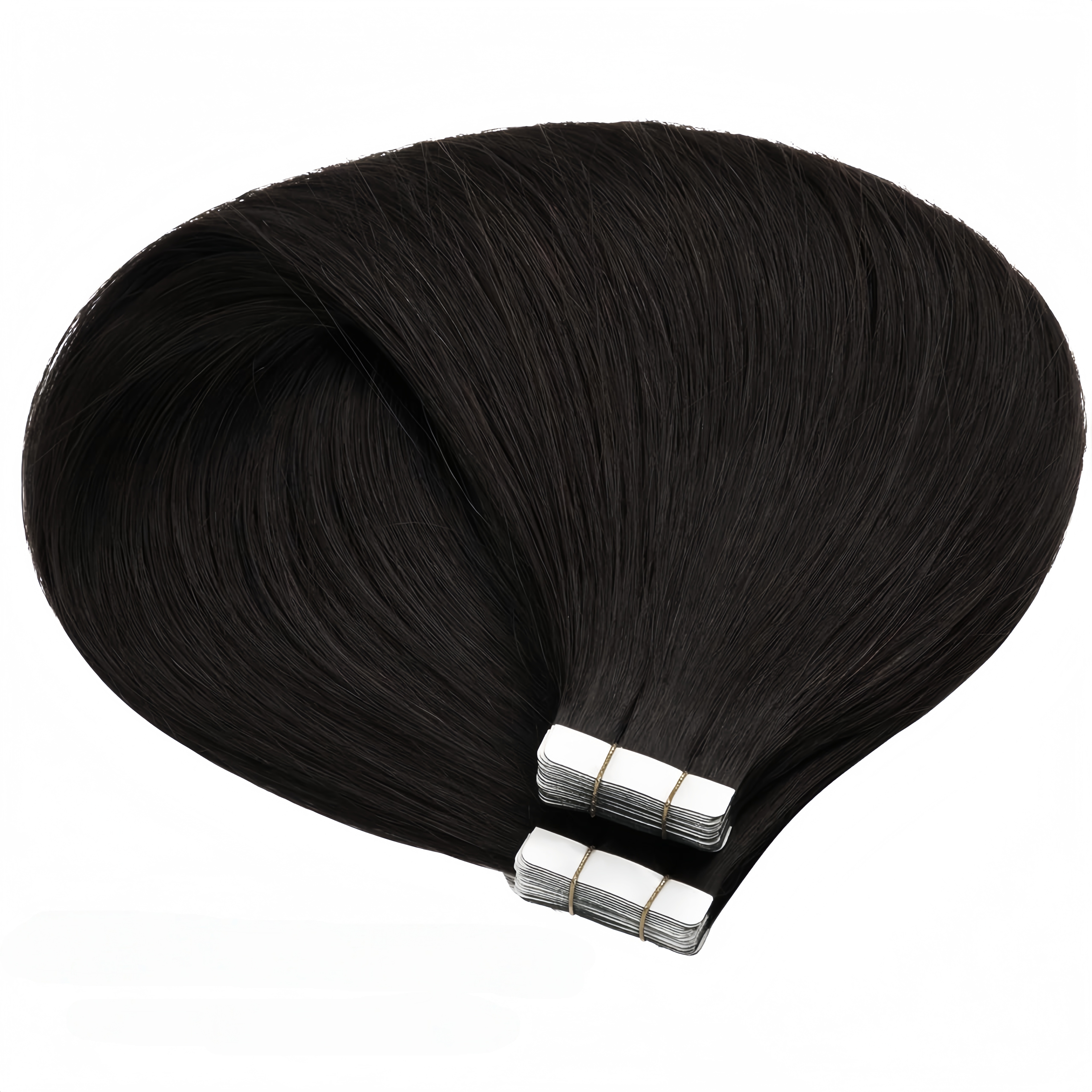
If you are evaluating your first order, the off-black tape-in extensions in #1B — straight texture, 14"–24", one-piece minimum — are a representative example of the series we manufacture to these specifications.
In the unit economics above, the client's repurchase depends entirely on one thing: does the hair still look good at week twenty? That is a quality question, and quality in tape-ins comes down to two documented variables.
Cuticle alignment. When every strand runs root-to-tip in the same direction, the cuticles lie flat and the hair resists matting through months of washing, sleeping, and wear. Aligned hair is why a premium set survives a nine-month cycle. Our cuticle-aligned tape-ins are rated for wear cycles of up to twelve weeks before repositioning. The science behind this — and the reason misaligned hair fails — is covered in how cuticle alignment works .
Remy versus non-Remy sourcing. Non-Remy hair is collected from mixed sources, so the cuticles run in opposing directions; manufacturers coat it in silicone to mask the friction, and the coating washes out within weeks. The differences between Remy and non-Remy hair are invisible on day one and unmistakable by week six — which is exactly when the client decides whether to rebook.
The commercial translation: hair grade is not a cost line, it is your repurchase-rate line. The $2 per weft "saved" on non-Remy stock is repaid in free move-up appointments, complaint handling, and a client who quietly books elsewhere next time.

Comparing Methods as a Business Decision
Clients choose an extension method for the look. Owners should choose for the calendar. The same client has very different commercial value depending on which method you install:
| Method | Rebooking cycle | Install time | Skill required | Annual revenue potential |
|---|---|---|---|---|
| Tape-in | Every 6–8 weeks (move-up) | 45–90 minutes | Moderate training | High — service fees + hair repurchase |
| Clip-in | None (self-applied) | None (client applies) | None | Low — one-time retail sale |
| Sew-in weft | Every 6–10 weeks | 2–4 hours | Braiding proficiency | Medium — long sessions, high chair cost |
| Keratin tip (I/U-tip) | Every 3–5 months | 3–6 hours | Advanced certification | Medium-high — premium pricing per session |
Read the table as a portfolio question. Tape-ins deliver the best ratio of recurring revenue to chair time for most salons, which is why they anchor the model in this guide. Sew-ins and keratin work still belong on the menu for the right clients — they simply should not be the growth engine, because their session lengths cap how many clients one stylist can retain.
Inventory Planning: How Much Tape-In Stock to Carry
Tape-in inventory is easy to get wrong in both directions: over-ordering ties up cash in colors that never sell, while under-ordering turns a booked install into a two-week wait. A simple model keeps it sane.
Start from your install rate. If your salon completes four full installs a week, at 30 wefts per install, you consume roughly 120 wefts weekly. Add your move-up replacement rate — wefts damaged in removal typically add 10–20% to consumption.
Layer in your lead time. Our factory-direct shipping runs one to four weeks depending on order size and customization. Stock one full lead-time cycle plus a two-week buffer — a salon on four-week shipping carries roughly six weeks of expected consumption.
Depth by color, not by product. Base colors carry the volume: #1B off-black and #1 natural black serve the majority of clients and justify the deepest stock. Fashion and light colors — like light blonde #60 tape-ins or the natural black #1 double tape-ins for clients who run darker — sell fewer units each, so hold them shallow and reorder on trigger rather than on schedule.
Use the MOQ as a testing tool. Because our tape-in series starts at a one-piece minimum, a new salon can trial a colorway or a length with a single unit instead of committing to a bulk pack. Test small, measure what your chair actually installs, then consolidate your reorder around proven movers.

Retention Systems That Turn Installs into Standing Appointments
The annual value calculated earlier assumes the client returns. Retention is not a marketing afterthought — it is the mechanism that converts your tape-in program from a service into an annuity. Four systems do most of the work:
- Book the move-up at checkout, every time. The next appointment should be scheduled before the client leaves the chair, not left to her memory — the January install client should already hold her March slot.
- Run a reminder cadence, not a single reminder. A confirmation at booking, a note at week four, a reminder at week six. By the cycle's end, rebooking feels like the client's own idea — because it is.
- Sell the aftercare kit at the install. Sulfate-free shampoo, extension-safe conditioner, and a bond-friendly brush protect the hair you installed and add retail margin. Clients using the right products show up to move-ups with hair worth repositioning.
- Own the replacement conversation proactively. Around month seven, the stylist — not the client — should raise the replacement set: "Your hair has held up beautifully; let's plan the new set for your October appointment." Framed as maintenance planning, it reads as expertise; left to the client, it reads as an upsell.
Salons that install these four systems routinely see the majority of tape-in clients convert to a year-plus cadence. Salons that don't watch the same clients drift to whoever reminds them first.
Sourcing Checklist: Protecting Your Margin Before You Order
Every risk in a tape-in program traces back to a sourcing decision, and most are cheap to check before the first order ships:
- Run a shed test on the sample. Brush the weft firmly from root to tip and count what comes out. The procedure takes two minutes and predicts your complaint rate better than any sales copy — our guide to testing hair extension quality covers five checks you can run yourself.
- Verify tape grade in writing. Ask the supplier to confirm adhesive grade and expected wear per cycle. Vague answers here become week-four service calls on your calendar.
- Confirm length and weight per weft. Short-weighted wefts are the quiet margin killer: an order billed as 18 inches that measures 17 delivers less hair per install than your pricing assumed.
- Order one batch of consistency before you commit to volume. Compare the sample against hair you already stock. The supplier's answer to "how do you control color between production runs" tells you what your September reorder will look like.
Buyers who skip these checks meet the same problems later at retail prices — the failure patterns are documented in our rundown of common problems salons face when buying hair extensions . A supplier who answers all four in writing and supports customization of color, length, texture, and packaging is structurally aligned with your retention model.
FAQ: Tape-In Extensions for Salons
How many tape-in wefts does a full head need?
Most full installs use 20 to 40 wefts. Fine-haired clients and volume-focused installs sit at the lower end; thick natural hair needs more wefts to blend the density line. Plan inventory around a 30-weft average per install.
How often should clients book a move-up?
Every six to eight weeks is the standard cycle — hair grows roughly half an inch a month, and the adhesive band needs to stay close to the scalp to stay hidden and comfortable. Our cuticle-aligned series supports wear cycles up to twelve weeks, but do not stretch a first-time client past eight until you have seen how her hair holds.
How long does one set of tape-in hair last?
Virgin, cuticle-aligned hair typically serves six to twelve months of continuous wear when the client follows aftercare guidance. That is the repurchase clock behind the annual-value math earlier in this guide.
Do tape-in extensions damage natural hair?
Installed and removed correctly — genuine adhesive, proper removal solution, no pulling — tape-ins are among the gentlest attachment methods, because weight spreads across a wide band rather than a point. Most damage attributed to tape-ins comes from rushed removals or skipped move-ups, not the method itself.
What should a new salon's first tape-in order look like?
Start with a one-piece-minimum supplier and order enough for two or three installs in your base colors — typically #1B and #1 — plus a single set in the lightest shade your market requests. Install, run the full retention cycle, and let the rebooking data tell you what to reorder.
Build the Cycle, Not Just the Sale
A tape-in program is not a product line — it is a compounding service cycle: install, move-up, move-up, replacement, repeat. Price the install in three layers, buy hair that survives the full cycle, stock your base colors deep, and put the rebooking system in place before your first client sits down. Do those four things and every install you sell quietly builds the next one.
Ready to run the numbers on your first order? Send us your target install volume and color mix — our guide on what to include in a quote request makes it easy — or contact our team directly and we will build a stocking plan for your salon.